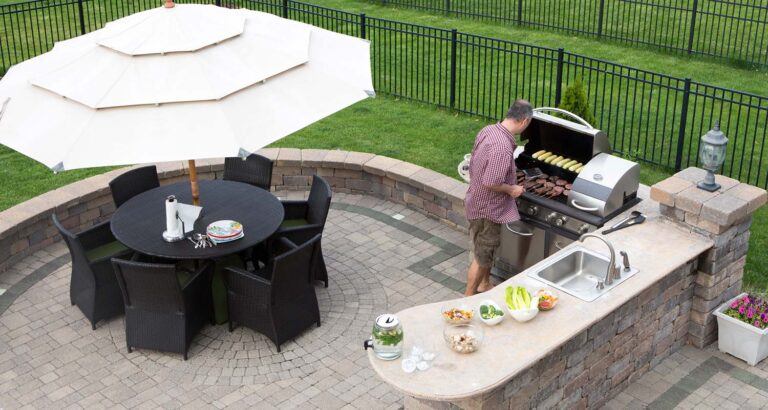
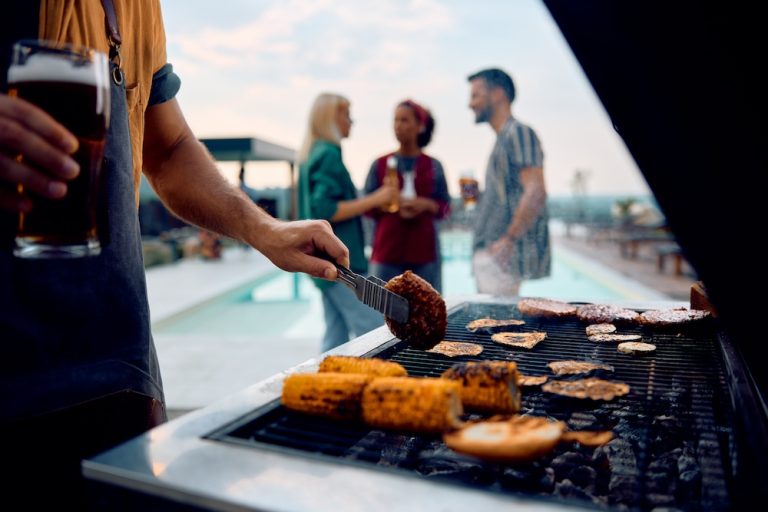
You’ve got a vision for your backyard. Maybe it’s a paver patio with a fire pit and a couple of Adirondack chairs. Maybe it’s a full outdoor kitchen, a pergola, and a separate lounge area with string lights. Maybe you’re not totally sure yet, but you just know you want to actually use your backyard this summer.
Whatever you’re picturing, this article is going to help you think through it the right way.
At Torchwood Landscaping, we design and build backyard entertaining spaces across West Michigan. We’ve seen what works, what doesn’t, and, more importantly, what gets skipped in the planning phase that costs homeowners real money later. We’re going to cover design ideas, layout concepts, and the features that make a nice backyard exceptional.
But we’re also going to talk about something most landscaping articles completely ignore: drainage. Because a beautifully designed backyard that floods every time it rains is just one more homeowner headache. And in West Michigan, where we get real rainfall and real winters, getting water management right is the foundation everything else is built on. Literally.
Start Here: What Do You Actually Want to Do in Your Backyard?
Before we talk materials, features, or budgets, the best question to ask is: how do you actually entertain?
Some people host big gatherings like family reunions, graduation parties, or neighborhood cookouts. Others want a space for smaller, more intimate evenings, like a few friends around a fire, dinner al fresco. Some want a place for the kids to play while adults have a drink nearby. Some want all of the above.
Your entertaining style drives your design. A homeowner who hosts twenty people needs different square footage, flow, and features than someone who uses their patio for quiet evenings with their spouse. Getting clear on this before you start picking pavers will save you a lot of second-guessing and money.
Here are the most common backyard entertaining zones we design and how they work together.
The Core Zones of a Great Backyard Entertaining Space
Zone 1: The Main Gathering Area (Dining + Seating)
This is the anchor of the whole space. It’s where people congregate, sit down, eat, and linger. Most homeowners underestimate how much square footage this zone actually needs.
A dining table that seats 6–8 people needs at least a 12×12 footprint, and that’s tight. Add comfortable movement around the chairs and you’re really looking at 14×16 ft or larger. For a combined dining and lounge zone, plan for 400–600+ square feet of usable hardscape.
What works well in West Michigan: Large-format concrete pavers or natural flagstone. Both hold up through freeze-thaw cycles, drain surface water effectively when properly graded, and look outstanding. Stamped concrete is also popular and more budget-friendly, though it requires occasional sealing to hold up long-term.
The drainage connection: This is where we have the first drainage conversation with every client. A patio that’s even slightly pitched the wrong way will pond water after every rain. We grade every patio surface with a minimum 1–2% slope away from the house and toward a designated drainage outlet. This is the difference between a patio you can use the morning after a storm and one that’s sitting under half an inch of water.
Zone 2: The Cooking Area
Whether it’s a simple built-in grill station or a full outdoor kitchen, your cooking zone needs to be positioned thoughtfully relative to the rest of the space. You want it close enough to the dining area that you’re not hiking plates across the yard, but with enough separation that the cook isn’t trapped behind a wall of guests.
Popular cooking setups we’re building right now:
- Built-in grill with flanking counter space: Clean, functional, and works at almost any budget.
- Full outdoor kitchen: We’re talking grill, refrigerator, sink, side burners, and a bar overhang where guests can pull up a stool. This is the entertainer’s dream setup.
- Pizza oven station: We’re building more of these every year. A wood-fired or gas pizza oven becomes the centerpiece of the whole gathering.
- Griddle + grill combo: This is popular with homeowners who love smash burgers, breakfast outside, and hibachi-style cooking.
The cooking zone should always be under or adjacent to a shade structure, both for the cook’s comfort and to help manage heat and smoke.

Zone 3: The Fire Feature
If there’s one feature that transforms a backyard from functional to magnetic, it’s a fire. People are drawn to it. Conversations happen around it. It extends the season: a fire pit in West Michigan lets you use your backyard comfortably from early spring through late fall.
Your main options:
Built-in gas fire pit: Clean, easy, instant on/off. No wood hauling, no smoke in your face. Typically $5000–$10,000 installed depending on size and materials. Gas is the most popular choice for homeowners who entertain frequently.
Wood-burning fire pit: More affordable to install ($2,500–$5,000 for a built-in masonry version), more experiential, but requires wood storage and more cleanup. Local municipalities have varying rules on open burning. It’s worth checking before you commit.
Linear fire feature or fire table: A modern, architectural look that works especially well in contemporary patio designs. These range from $3,000–$12,000+ and double as a coffee table or focal point.
Outdoor fireplace: This is the most dramatic option. A masonry outdoor fireplace anchors a space the way nothing else does, but it’s also the biggest investment: $10,000–$20,000+ depending on size and construction.
Tip: Position your fire feature downwind from the primary seating area based on your property’s prevailing wind direction. This small planning detail makes a big difference in usability.
Zone 4: The Lounge Area
This is the zone people linger in after dinner. Comfortable deep-seat furniture, maybe an outdoor sectional, a low coffee table, and soft lighting. It’s the zone that makes a backyard feel like an outdoor living room rather than just a patio.
In West Michigan, shade is important here. The afternoon sun on a southwest-facing patio can make a lounge area unusable in peak summer without some cover overhead. A pergola, shade sail, or planted arbor solves this and adds significant visual interest to the space.
Shade and Cover: The Feature That Gets Skipped
Shade structures are one of the most underbuilt elements in West Michigan backyards. Homeowners plan beautiful patios and then discover that a 3 pm Saturday in July is too hot to sit outside without shade. Don’t make this mistake.
Pergolas are the most popular option: open-roof structures with rafters that filter light without blocking it entirely. Cedar pergolas have a warm, natural look. Aluminum pergolas are virtually maintenance-free. Vinyl is a cost-effective middle ground. Budget $14,000–$20,000+ for a quality installed pergola depending on size and material.
Bioclimatic pergolas with motorized louvers are the current high-end trend. You can open them to let sun in or close them fully to shed rain. They run $20,000–$40,000+ but effectively make your outdoor space usable in rain.
Attached shade structures with solid roofs create true four-season usability. Add a ceiling fan, a heater, and proper lighting and you’ve got a space you’ll use from April through November in Michigan.
Shade sails are a lower-cost option ($500–$2,000 installed) that can look sharp in a modern design but don’t address rain.
Lighting: The Detail That Changes Everything After Dark
Outdoor lighting is the single most underinvested feature in most backyard projects, and the one that makes the biggest visual impact. A well-lit space looks completely different at 9 pm than an unlit one.
Think in layers:
- Task lighting over the cooking area and any work surfaces, like recessed or pendant lights under a pergola, or directional fixtures aimed at the grill station
- Ambient lighting for the overall space, like string lights strung across a pergola remain the most popular and effective option for a warm, social atmosphere
- Path and step lighting for safety and to define the edges of your space, like low-voltage LED fixtures along paver borders or step risers
- Feature lighting to highlight landscape plantings, a water feature, or your fire pit structure
A well-designed lighting package runs $5,000–$15,000 installed for a full backyard entertaining space. It’s one of the best investments per dollar in the entire project.
The Drainage Conversation Everyone Avoids (Until It’s a Problem)
Here’s the thing about backyard entertaining spaces: beautiful hardscape, great furniture, the perfect fire pit—none of it matters if your yard doesn’t drain correctly. And in West Michigan, with our clay-heavy soils and significant rainfall, drainage is one of the most common problems we’re called in to solve.
The worst time to discover you have a drainage problem is after you’ve already poured a concrete patio or installed $30,000 worth of hardscape. We always assess drainage before design, and here’s why.
Standing Water and Ponding
If your yard holds water after rain, adding hardscape makes it worse, not better. Impervious surfaces like concrete and standard pavers redirect water rather than absorbing it. If that water has nowhere to go, it pools. We need to know where your yard’s low points are and where water currently flows before we place a single paver.
The fix: Proper grading and, in many cases, a French drain system installed before or alongside the hardscape. A French drain runs $45–$65 per linear foot for exterior yard installations, with most full backyard drainage projects running $4,000–$10,000 depending on the size of the problem and how far the water needs to travel to an outlet.
Water Running Toward the House
This is the most urgent drainage issue we see. If your patio slopes toward the foundation, or if water from the yard collects against the house, you’re looking at potential basement moisture, foundation issues, and long-term structural problems. No patio is worth that.
The fix: Regrading the area around the patio to establish positive drainage away from the foundation. In some cases, a channel drain (also called a linear drain) installed along the back of the house or the edge of the patio intercepts water before it reaches the foundation. Channel drain installations typically run $2,500–$4,500 depending on length and outlet requirements.
Soggy Lawn Around the Entertaining Area
A patio that stays dry but dumps water onto the lawn next to it creates a soggy no-man’s-land that nobody wants to walk through. If you’re planning lawn areas, a putting green, or garden beds adjacent to your entertaining space, water management around the hardscape edges matters.
The fix: Permeable paver options can help at the edges of the space, allowing water to infiltrate rather than run off. We also commonly install perforated pipe systems at the perimeter of patio areas that collect and redirect water before it saturates the adjacent lawn.
West Michigan Clay Soil
Here’s the local reality: much of West Michigan sits on heavy clay. Clay sheds water instead of absorbing it. This makes surface grading and subsurface drainage even more critical here than in markets with sandy or loamy soils. If a contractor isn’t talking to you about your soil type and drainage plan, they’re skipping a step that will matter later.
Putting It All Together: How These Spaces Come to Life
The best backyard entertaining spaces in West Michigan are designed as cohesive patterns. The patio anchors the space. The cooking zone gives it purpose. The fire feature gives it warmth and draw. The shade structure makes it usable for more months of the year. The lighting makes it magical after dark. And the drainage underneath all of it makes sure it actually performs.
A well-designed backyard entertaining space isn’t finished in one year. Many of our clients start with the patio, fire pit, and a basic cooking setup, then add the pergola and outdoor kitchen in year two, and finish with lighting and landscaping the year after. That’s a completely reasonable approach as long as the drainage and grading are done correctly from the start, so each phase builds cleanly on the last.
Frequently Asked Questions About Backyard Entertaining Spaces
What’s the most important thing to get right in a backyard entertaining space? Drainage and grading. It’s not the most exciting answer, but it’s the honest one. A beautiful space that pools water after rain, or that directs water toward your foundation, is a problem that gets more expensive to fix the longer you wait.
How much does a backyard entertaining space cost in West Michigan? A basic patio with a fire pit and seating area starts around $8,000–$15,000. A mid-range space with a patio, outdoor kitchen, pergola, and lighting runs $35,000–$70,000. A full premium build with custom masonry, outdoor kitchen, fireplace, pergola, and professional landscaping can reach $80,000–$150,000+. Most of our clients fall somewhere in the middle, building in phases over a few years.
What hardscape material is best for West Michigan’s climate? Concrete pavers are our most commonly recommended option. They handle freeze-thaw cycles better than poured concrete (individual pavers can shift and be reset; a cracked concrete slab cannot), they come in a wide range of styles, and they drain well when properly installed. Natural flagstone is a beautiful premium option. Porcelain pavers are increasingly popular and highly durable.
Do I need a permit for a patio, pergola, or fire pit in West Michigan? It depends on your municipality and the scope of work. Detached pergolas under a certain size often don’t require permits; attached structures typically do. Outdoor fireplaces and gas fire pits almost always require permits. We handle permitting for every project we build.
How do I fix drainage problems in my existing backyard? Start with a drainage assessment. Look at where water is coming from, where it goes, and what the soil conditions are. Solutions range from simple regrading ($500–$2,000) to French drain installation ($2,000–$8,000) to more complex catch basin and piping systems for severe problems. We offer drainage consultations and can assess your specific situation.
When is the best time of year to start a backyard entertaining project in West Michigan? Plan in winter, design in early spring, build in spring and early summer. The best projects are the ones that are completed early enough in the season to actually be enjoyed. We recommend reaching out by February or March to get on the schedule for the summer season.

Ready to Design Your Backyard Entertaining Space?
If you’re serious about building a backyard that you’ll actually use, one that’s designed right, drains right, and looks great, we’d love to talk.
At Torchwood Landscaping, we specialize in outdoor living spaces and drainage for West Michigan homeowners. We build spaces that hold up against our weather, our soil, and our seasons.
Contact Torchwood Landscaping to schedule an on-site consultation. We’ll walk your property, assess your drainage, talk through your vision, and put together a plan that makes sense for your budget and timeline.
Torchwood Landscaping serves homeowners across West Michigan, including Grand Rapids, Holland, Zeeland, Hudsonville, Jenison, Byron Center, Ada, Rockford, and surrounding communities.