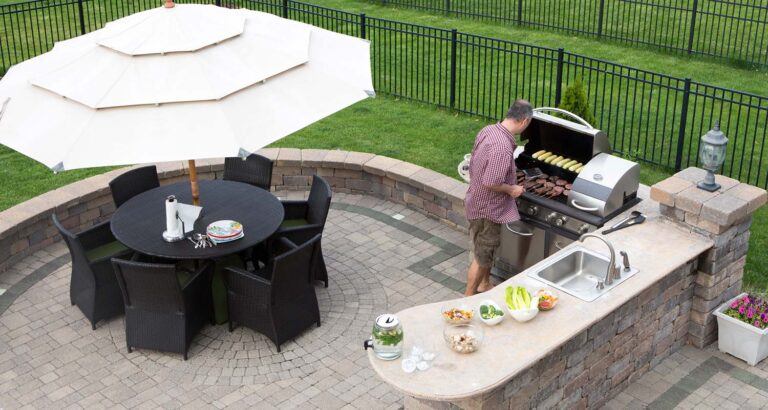

Have you ever taken a step across your patio and felt one of the pavers shift under your feet? (We know—it causes a little bit of an adrenaline rush.)
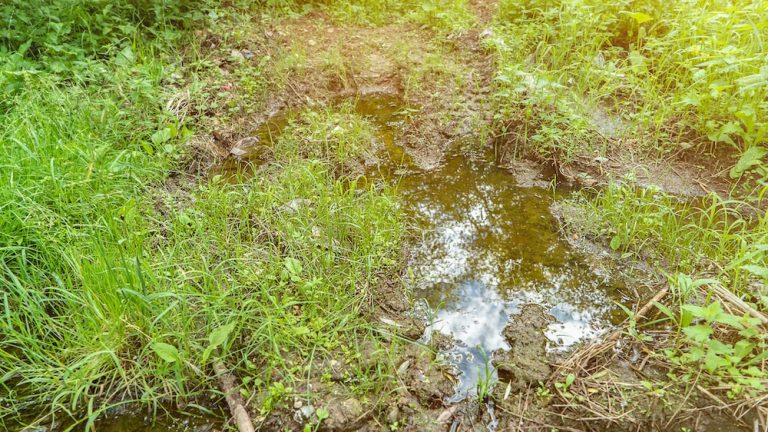
Or have you seen puddles in the middle of your patio after a storm?
Maybe you’ve noticed that the edges of your paver patio have started to dip and pull away from the house.
If you’ve seen any of the above, you’ve seen what we see at Torchwood Landscaping almost every week.
Most paver patios in West Michigan start to crack, flood, or dip within five years. Not because the pavers themselves are bad. Concrete pavers are arguably the most durable hardscape material on the market. They’ll outlast the house in most cases.
The real issue is typically drainage. Our unique clay soil in Michigan doesn’t lend itself to natural drainage, so if you haven’t solved that issue before installing a patio, you’ll start to see the signs.
This is the post we wish every Grand Rapids homeowner read before they signed a contract for a new patio. We’re going to walk you through exactly why drainage is the single biggest factor that determines whether your patio lasts five years or thirty, what proper drainage-first patio design actually looks like in West Michigan, what it costs, and what to ask any contractor before you hire them.
Why Paver Patio Drainage is a West Michigan Problem
Building a paver patio in Phoenix is one thing. Building one in Grand Rapids, Holland, or Hudsonville is a completely different engineering challenge, and most national how-to guides don’t account for it.
Three things make our region uniquely brutal on patios:
- Clay soil. Most yards in Kent, Ottawa, and Allegan counties sit on dense clay or clay-heavy loam. Clay holds water like a sponge that never wrings out. When the soil under your patio stays saturated for weeks at a time (which is normal here in spring and late fall) it loses bearing capacity. Pavers settle. Edges sag. Joints open up.
- Freeze-thaw cycles. Grand Rapids averages around 100 freeze-thaw cycles per year. Every cycle, water in the base material expands roughly 9 percent as it freezes, then contracts when it thaws. If water is sitting in or under your patio, that expansion lifts pavers, cracks joints, and pushes everything around. Over five years, that’s 500 cycles of mechanical destruction.
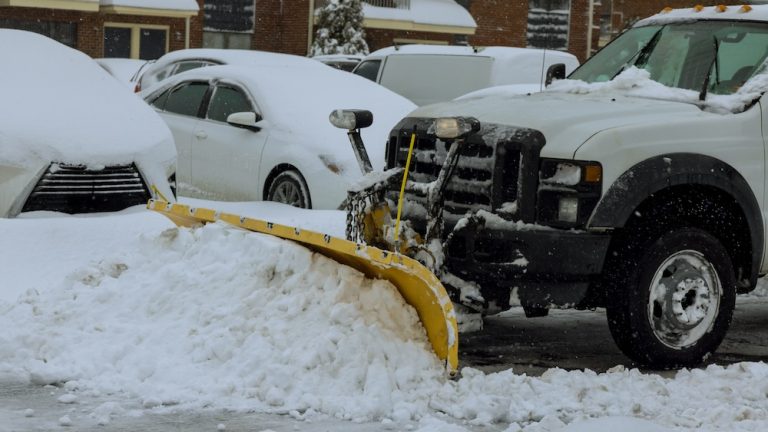
- Spring snowmelt and lake-effect storms. A heavy lake-effect snowfall followed by a 50-degree thaw can dump the equivalent of a small flood onto your hardscape in 48 hours. If the patio doesn’t have a path for that water to leave, it pools, then freezes again the next night.
Put these three together and you have the perfect storm for paver failure. A patio built without serious drainage design is essentially being asked to absorb a flood, freeze it, and survive over and over for decades.

How Drainage Issues Kill A Paver Patio
When we get called out to repair a failing patio in Cascade, Forest Hills, or East Grand Rapids, we usually find one or more of these five problems.
Failure 1: Saturated base
The base material, usually crushed concrete or 21AA limestone, is supposed to be a free-draining layer that lets water move through and out. When the patio doesn’t have a way to shed water, or when the base was installed over compacted clay with nowhere for water to go, the base stays wet. Wet base plus freeze-thaw equals pavers that settle, rock, and crack at the edges.
Failure 2: No slope, or the wrong slope
A paver patio should pitch away from the house at roughly 1/4 inch per foot, about a 2 percent slope. We’ve inspected dozens of patios that were installed dead level, or worse, sloped toward the house. That water has to go somewhere, and “somewhere” is usually the foundation.
Failure 3: Edge restraint blowout
Edge restraint holds the perimeter of a paver patio in place. When water saturates the soil behind the restraint, freezes, and expands, it pushes the restraint outward. Pavers along the edge then slide, rotate, and create gaps. By year three, you’ve got a patio that looks like it has cavities.
Failure 4: Downspouts dumping onto the patio
This one is shockingly common. A roof can shed thousands of gallons of water during a single Michigan downpour. If your downspouts dump directly onto the patio or the soil right next to it, you’re concentrating that flow in one spot, washing out the base and saturating the foundation soil.
Failure 5: Surrounding yard drainage that pushes water under the patio
If the rest of your yard slopes toward the patio, every storm sends sheet flow under the pavers. The base never dries. The pavers heave. Most patio contractors don’t even look at the surrounding yard before quoting and instead treat the patio area like an island. It isn’t.
What Drainage-First Patio Design Actually Looks Like
Here’s how a Torchwood patio is built differently when we know we’re working in West Michigan soil.
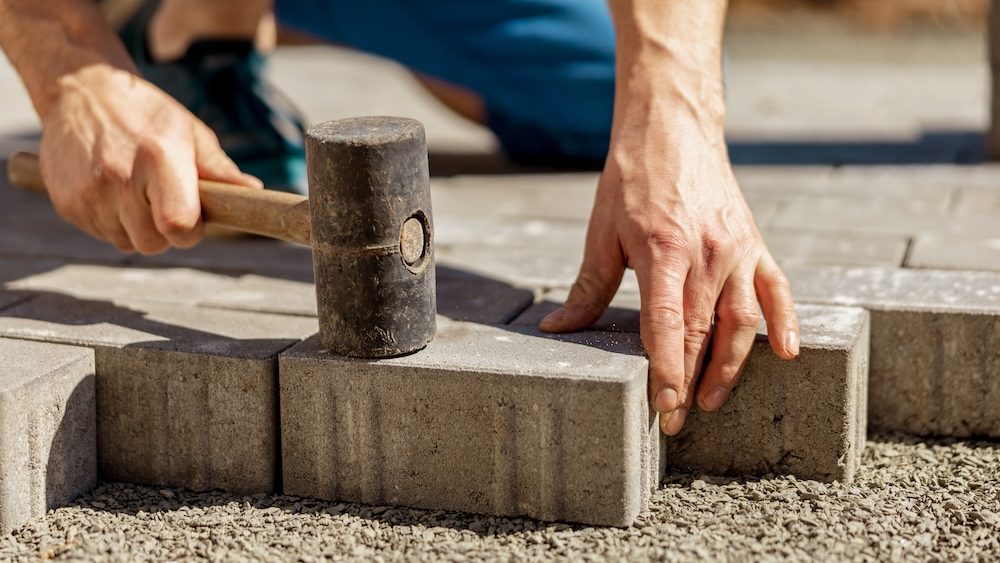
- We dig deeper than the standard. A typical residential paver install calls for 6 inches of compacted base. In our market, we typically install 8 to 12 inches, depending on soil tests. More base equals more drainage capacity equals longer life.
- We use a free-draining base material. Crushed limestone (21AA or 23A) is the West Michigan standard for a reason: it locks together for stability while letting water pass through. We don’t use sand-only bases, which lose strength when wet.
- We install a perimeter drain or core drain when needed. On heavy clay sites we’ll often run a perforated drain pipe around or under the patio that ties into a daylighted outlet, a dry well, or a storm system. That gives water a clear, designed path off the property.
- We design the slope before we touch a paver. 2 percent minimum, away from any structure, with the runoff routed to a managed receiving area, never just “into the lawn” if the lawn already has standing water issues.
- We address the surrounding yard. Before quoting a patio, we walk the whole property looking for upstream drainage problems. If your yard pushes water toward the patio area, fixing that is part of the patio job, not a separate project.
- We re-route any nearby downspouts. Downspouts get tied into buried 4-inch SDR pipe and daylighted well away from the patio.
That’s the difference between a five-year patio and a thirty-year patio.
How Much Does Patio Paver Drainage Cost in Grand Rapids?
In the West Michigan market right now, here’s what you’re looking at for a paver patio:
- Basic paver patio, sand-set, standard 6-inch base, no drainage work: roughly $14 to $17 per square foot. This is what most low-bid contractors are quoting. It’s also where most failures come from.
- Properly built paver patio with 8–12-inch base, edge restraint, designed slope, and included drainage tie-ins for downspouts: roughly $22 to $32 per square foot.
- Premium drainage-first patio with perimeter drain, dry well or daylighted outlet, integrated landscape grading, and high-end pavers (Techo-Bloc, Unilock, Belgard): typically $32 to $48 per square foot.
A 400-square-foot patio under the second tier, which is what we’d consider the West Michigan minimum spec, runs about $8,800 to $12,800 installed.
That’s more than the $5,600 to $6,800 a low-bid contractor will quote for the same square footage. We get that. The reason we recommend the higher spec is simple: the cheap patio costs more in the long run, because you’ll pay to fix it or rip it out within a decade. The right patio is a one-time expense.
How to Tell if Your Patio Has A Drainage Problem
If you already have a patio and you’re wondering whether it’s set up to last, here’s a quick checklist you can run yourself.
- After a heavy rain, walk out and look for puddles that don’t drain within an hour. That’s a pitch or base problem.
- Step on every paver, especially in the middle and along the edges. Any rock, wobble, or sponginess means the base is saturated or settling.
- Look at the joints. If the polymeric sand has washed out in low spots, water is flowing across (or under) the patio in a concentrated path.
- Check the perimeter. Are pavers along the edge tilted, separated, or sliding outward? That’s edge restraint failure, almost always driven by saturated soil behind the restraint.
- Follow your gutters. Where do your downspouts dump? Anywhere within 8 feet of the patio is a problem.
If you’ve got two or more of these signs, your patio has a drainage problem, and it’s going to get worse every winter you ignore it.
What to Ask A Contractor Before You Hire Them
This is the section we hope every Grand Rapids homeowner saves before they get a quote, regardless of who they hire. If a contractor can’t give clear answers to these questions, keep looking.
- How deep will the base be? (Right answer for West Michigan: 8–12 inches, not 6.)
- What base material will you use? (Right answer: crushed limestone — 21AA or 23A. Wrong answer: just sand.)
- How will the patio be sloped, and where will the runoff go? (Right answer: 2 percent minimum away from structures, with a specific receiving area.)
- Will you address my downspouts? (Right answer: yes, by routing them through buried pipe to a daylighted outlet.)
- Have you walked the rest of my yard for upstream drainage issues? (Right answer: yes, with specific observations.)
- What edge restraint will you use, and how is it secured? (Right answer: a proven aluminum or composite edge restraint with 10-inch spikes — not flimsy plastic.)
- What’s your warranty, and what does it specifically cover? (Right answer: clear language about settlement, base failure, and drainage-related issues — not just “we’ll come back and re-level once.”)
If a contractor’s eyes glaze over at question 3 or 5, you’ve already learned everything you need to know.
Frequently Asked Questions
Do paver patios crack in Michigan winters?
Properly installed paver patios don’t crack. Individual pavers are too small and too flexible at the joints to crack the way a concrete slab does. What fails on a poorly built paver patio is the base, not the pavers themselves. Pavers settle, rock, and shift, but the stones stay intact. That’s actually one of pavers’ biggest advantages over concrete in our climate.
How long should a properly built paver patio last in Grand Rapids?
A drainage-first paver patio installed to West Michigan spec should last 25 to 40 years with minimal maintenance, typically just polymeric sand re-application every 8 to 10 years.
Can you fix a failing patio without tearing it out?
Sometimes. If the failure is limited to settled pavers and the base is mostly sound, we can lift, re-grade, and re-set sections. If the base is saturated or undersized, the only honest fix is a full rebuild.
Is a concrete patio a better choice in our climate?
Not in our opinion. Concrete in Michigan freezes, cracks, and offers no second chances when it does. Pavers can be lifted, replaced, and adjusted individually. They handle freeze-thaw better because they’re designed to move at the joints.
Do I need a permit for a paver patio in Grand Rapids?
For a standard ground-level patio, usually no. If your patio is attached to a structure, raised more than 30 inches, or includes a permanent roof, you’ll likely need one. Always check with your specific township. Cascade, Ada, and Forest Hills each have their own rules.
The Bottom Line
A paver patio is one of the highest-ROI investments you can make in a West Michigan home—outdoor-living projects in Michigan typically return 55 to 80 percent of cost on resale—but only if it’s built to handle the way water moves through Grand Rapids soils.
Most patios in our market aren’t.
If you’re considering a new build, please get at least one quote from a contractor who treats drainage as part of the patio design, not as a separate problem. And if you’re staring at a patio that’s already failing, don’t wait. Every winter makes it worse.
We’re happy to take a look at your project. We’ll tell you the truth about what we see, what it’ll cost to do right, and whether your existing patio is worth saving, even if the answer is one you’d rather not hear. Reach out to us to request an estimate or use our cost estimator tool to get an idea for how much your project might cost.